
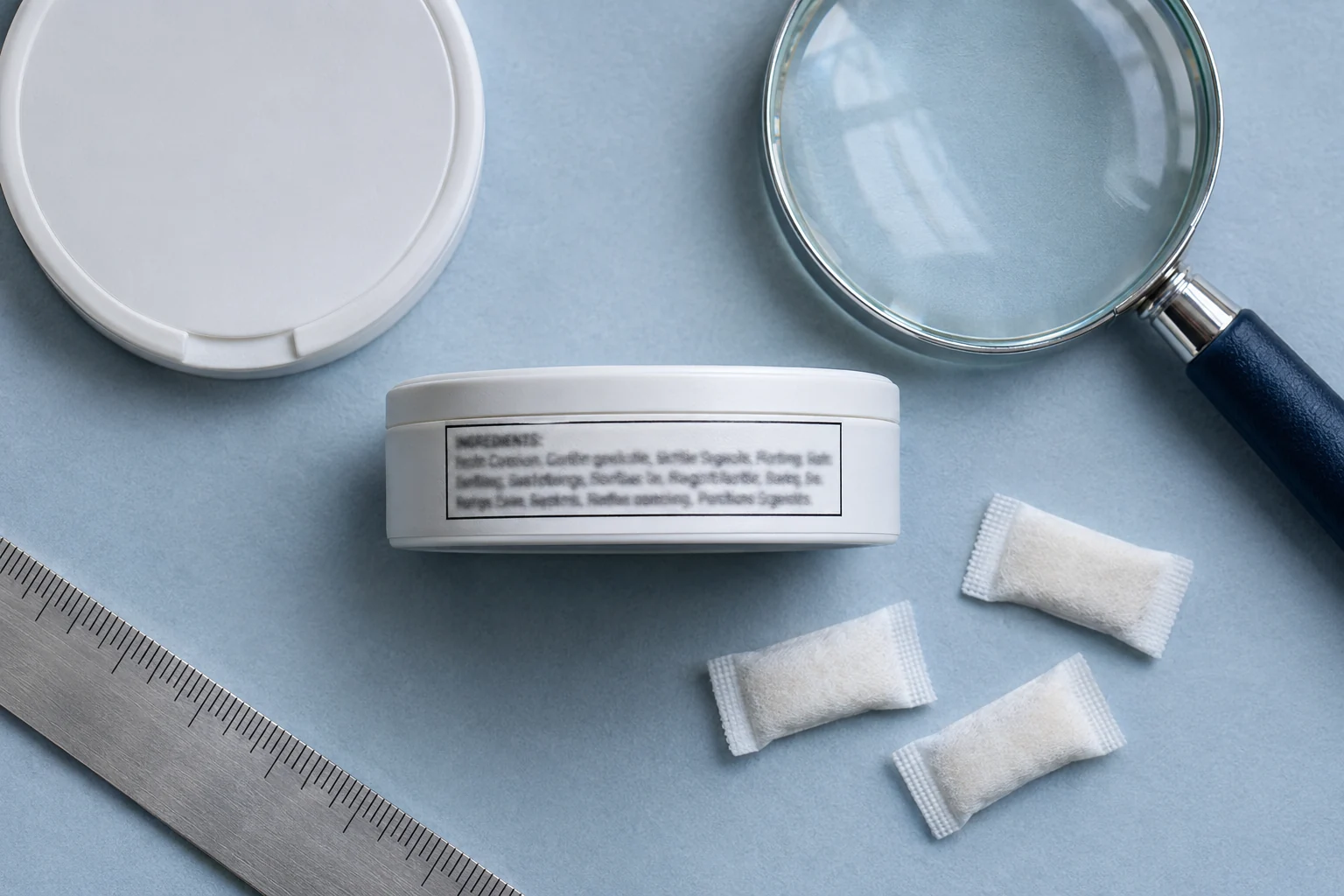
Start with the exact product
The name on the lid rarely identifies the whole product. Record the brand, line, flavor, declared strength, pouch format and intended market. A similar-looking can sold in another country may have a different ingredient list or number of pouches. Keep the label language and the date of the photograph with the record.
Use the side and bottom panels as well as the lid. A large strength number on the front may omit the unit used elsewhere. An online listing can combine several strengths under one parent page, so the selected variation matters. Save the specific source URL and check that its picture, title and label describe the same variation.
Separate a pouch from a serving
Milligrams per pouch describe one pouch. Milligrams per serving describe the labeled serving, which can contain more than one pouch. Concentration in milligrams per gram describes the filling by mass. These values answer different questions and should have separate fields in a comparison.
For a hypothetical filling containing 12 mg per gram, a 0.5 g portion contains 6 mg. This calculation only works when the concentration and portion weight use the same material basis. A weight including the wrapper, or a concentration expressed on a dry basis, can make a simple multiplication misleading. The result also says nothing about the amount absorbed into the body.
Read active ingredients and supporting ingredients
An active ingredient list describes the substances that support the product positioning. A second list can identify the carrier, sweetener, flavor, humectant and pH adjuster. These supporting ingredients affect texture, stability and sensory properties. Their presence does not establish a clinical effect.
ZYN publishes a functional breakdown of several ingredients in its US FAQ. Grinds publishes flavor-specific lists and distinguishes coffee-based products from its other lines. These disclosures are useful, but a list of names usually does not reveal the amount of every ingredient or the manufacturing process.
Keep a blend total intact
A proprietary blend can disclose the combined weight of several ingredients while withholding their individual amounts. Store that total against the blend itself. Dividing it equally, or borrowing a dose from a study, would create values the label never supplied.
Plant extracts need an additional check. The weight of an extract is different from the amount of a marker compound within it. A mineral salt has a different mass from the elemental mineral it supplies. Record the stated form, amount and unit before attempting any conversion. If the assay or composition is missing, leave the conversion unresolved.
Treat claims and measurements separately
Statements about focus, calmness, speed or duration are claims. A label can show that a brand declares 50 mg of caffeine without proving a particular onset time. A laboratory report can measure an ingredient without testing the advertised experience. An ingredient study can investigate a different dose or route from the pouch.
Create separate entries for the claim, the declared composition and any supporting study or test. Check whether the evidence involves the finished product and the same formulation. This separation lets a reader follow the reasoning instead of accepting a claim because it sits next to a scientific-looking number.
A useful label record
A reusable record contains the exact product identity, market, serving size, each disclosed active amount, other ingredients, warnings, storage directions and the source date. Photographs should show the relevant panels clearly. A current product page and an older label should remain distinguishable.
Use explicit states for missing information. Not disclosed means the source gives no value. Not tested means no measurement is available. Not detected belongs to a named laboratory method and its detection limit. None of these states should silently become zero. The label checker on this site measures documentation completeness; it does not grade safety or efficacy.
Questions to explore
Sources
- ZYN US: ingredients and product FAQ Official brand
- Grinds: product and ingredient FAQ Official brand
- NIH: Dietary Supplement Label Database Label database
- NIH ODS: dietary supplements, what you need to know Government reference
- NicoLeaks: testing scope and interpretation Testing methodology
Source review date: . How we evaluate sources